
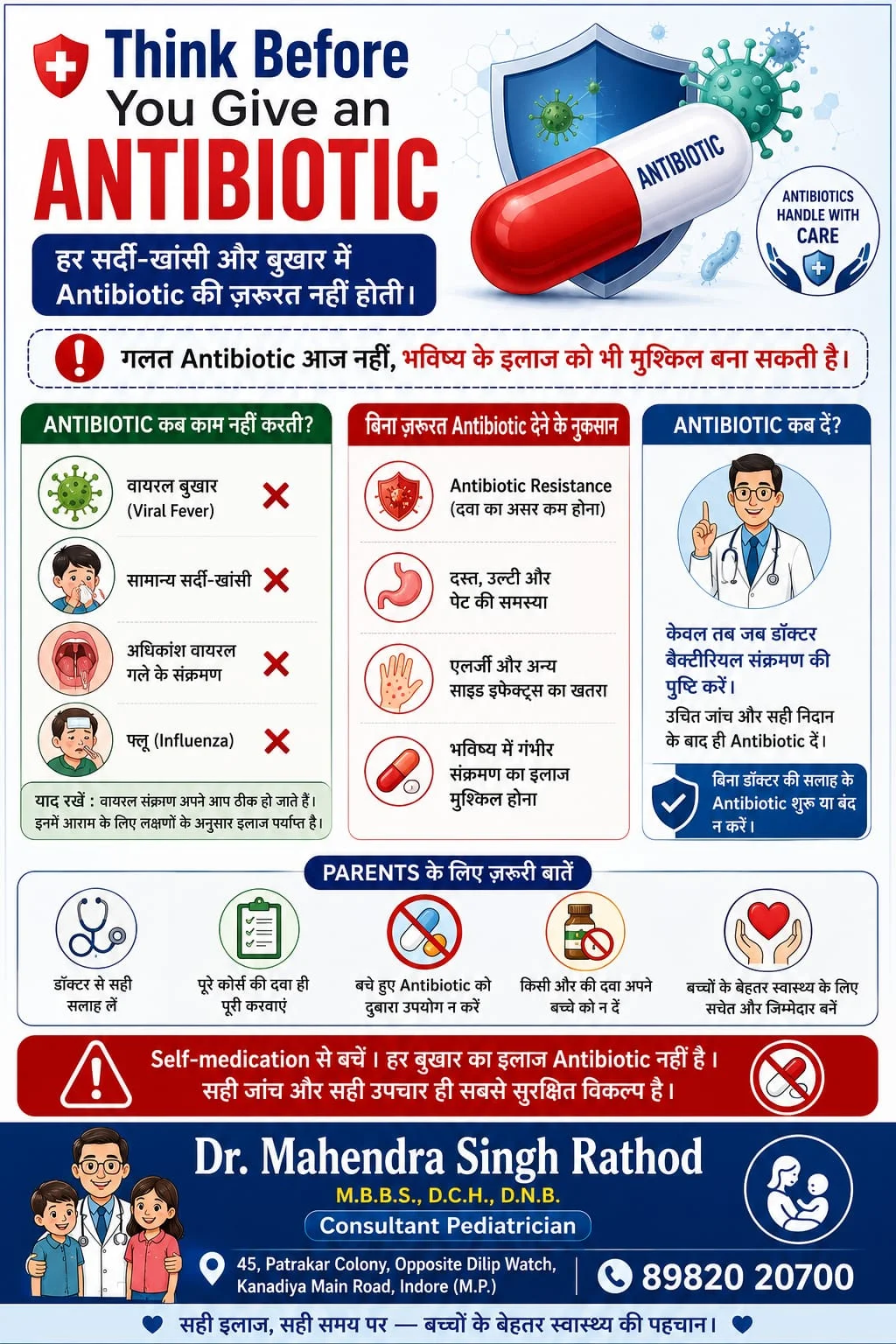
Think Before You Give an Antibiotic: A Parent’s Guide to Responsible Antibiotic Use in Children
When a child develops fever, cough, cold, sore throat, ear discomfort, or a runny nose, parents naturally want quick relief. In such moments, antibiotics may seem like the strongest or fastest treatment. However, antibiotics are not suitable for every infection, and giving them without a proper medical evaluation may expose a child to unnecessary side effects while contributing to antibiotic resistance.
The message Think Before You Give an Antibiotic encourages parents to pause, consult a qualified paediatrician, and understand whether the illness is likely to be bacterial or viral. Antibiotics can be life-saving when used for an appropriate bacterial infection, but they do not treat viruses responsible for most common colds, influenza, and many childhood respiratory illnesses.
For families seeking responsible child healthcare in Indore, Dr. Mahendra Singh Rathod provides medical evaluation and treatment guidance based on the child’s symptoms, age, clinical condition, and possible cause of infection.
Antibiotics are medicines used to kill certain bacteria or prevent them from multiplying. They are prescribed for specific bacterial infections after a healthcare professional determines that they are likely to be beneficial.
Antibiotics may be required for conditions such as certain bacterial urinary infections, bacterial pneumonia, some skin infections, streptococcal throat infections, and other diagnosed bacterial illnesses. The choice of medicine, dosage, frequency, and duration depends on several factors, including:
Parents should not select an antibiotic based on a previous prescription because two illnesses with similar symptoms may have entirely different causes.
Bacteria and viruses are different types of disease-causing organisms. Antibiotics are designed to act against bacteria and cannot eliminate viruses.
Many common childhood illnesses are viral, including:
Giving antibiotics for a viral illness does not help the child recover faster or prevent the virus from spreading.
Occasionally, a viral infection may later be complicated by a bacterial infection. A doctor should evaluate the child again if symptoms worsen, persist unexpectedly, or new warning signs appear. Parents should not start antibiotics in anticipation of such a complication.
Antibiotic resistance develops when bacteria change in ways that allow them to survive medicines that previously killed them or stopped their growth. Resistant infections may become more difficult to treat and may require alternative antibiotics, longer treatment, or hospital-based care.
Resistance develops in bacteria—not in the child’s body. However, unnecessary or inappropriate antibiotic exposure creates conditions that encourage resistant bacteria to survive and multiply. The World Health Organization identifies misuse and overuse of antimicrobials as major drivers of antimicrobial resistance.
Every time an antibiotic is used, it can cause side effects and contribute to resistance. This does not mean antibiotics should be avoided when genuinely required. It means they should be used only after appropriate medical advice.
Parents sometimes believe that taking an antibiotic “just in case” is harmless. In reality, every medicine has potential risks.
Possible antibiotic side effects may include:
Some reactions are mild, but others may require urgent medical care. Treating viral infections with antibiotics may expose children to these risks without offering a meaningful benefit.
Parents should seek emergency assistance if a child develops breathing difficulty, facial or lip swelling, severe rash, unusual drowsiness, or another serious reaction after taking medicine.
Fever is a symptom, not a diagnosis. It may occur with bacterial or viral infections and cannot determine the need for antibiotics by itself.
A doctor may assess the child’s age, temperature pattern, breathing, hydration, activity, examination findings, and associated symptoms before recommending treatment.
Most colds are viral and do not improve with antibiotics. Green or yellow nasal mucus alone does not prove that a bacterial infection is present.
A cough may result from a viral respiratory infection, allergy, asthma, throat irritation, or other causes. Antibiotics will not immediately soothe or stop a cough, even when a bacterial infection is eventually diagnosed.
Many childhood sore throats are viral, particularly when accompanied by coughing, nasal discharge, or hoarseness. A doctor may recommend examination or testing when bacterial throat infection is suspected.
Not every earache requires antibiotics. Some infections may improve with observation and symptom relief, while others require treatment depending on the child’s age, symptoms, examination findings, and severity.
Do not purchase or give prescription antibiotics based only on symptoms, pharmacy advice, a family member’s experience, or information found online.
Children’s antibiotic doses are often calculated according to body weight. Giving too little may make treatment ineffective, while giving too much may increase the risk of harm.
Use the measuring device provided with liquid medicines rather than an ordinary household spoon.
Give each dose at the interval advised by the doctor. Do not repeatedly delay doses or double the next dose unless a healthcare professional specifically instructs you to do so.
Current antibiotic courses vary depending on the infection, medicine, age, and treatment guidelines. Follow the duration prescribed for that specific illness rather than independently shortening or extending it.
An antibiotic prescribed for one child should never be given to a sibling, friend, or adult. The other person may have a different illness, dosage requirement, allergy risk, or medical condition.
Leftover antibiotics may be expired, improperly stored, contaminated, insufficient for a full course, or unsuitable for the current infection.
Contact the treating doctor if the child develops persistent diarrhoea, vomiting, rash, worsening symptoms, or difficulty taking the medicine. Severe allergic symptoms require urgent care.
When a doctor determines that the illness is likely viral, the treatment plan may focus on comfort, hydration, observation, and recovery rather than antibiotics.
Depending on the child’s age and medical advice, supportive care may include:
Parents should avoid giving cough, cold, fever, or herbal medicines without checking whether they are safe for the child’s age.
Seek timely paediatric care if the child has:
Infants, children with chronic illnesses, and those with reduced immunity may require earlier assessment. Medical decisions should not be based solely on the duration or colour of symptoms.
A good medical consultation is a partnership. Parents may ask:
These questions help parents understand the plan and reduce unnecessary medicine use.
Appropriate antibiotic use benefits not only one child but also the wider community. Resistant bacteria can spread between family members, patients, healthcare settings, and communities.
Parents can support antibiotic awareness in Indore by:
Responsible use helps preserve the effectiveness of antibiotics for children and adults who genuinely need them.
No. Fever can occur with viral and bacterial illnesses. The need for antibiotics depends on the diagnosis, examination findings, age, and clinical condition—not fever alone.
Routine antibiotic use for viral infections generally does not prevent later bacterial infections and may cause unwanted side effects.
Continue the medicine according to the doctor’s instructions unless the treating clinician changes the plan. Do not independently stop, extend, or modify the dosage.
No. Similar symptoms can have different causes, and the old medicine may be unsuitable, expired, incorrectly stored, or available in an inadequate quantity.
Antibiotics are valuable medicines, but their power must be protected. The safest approach is not to demand an antibiotic or avoid one automatically—it is to use the right medicine for the right infection after a proper medical assessment.
The principle Think Before You Give an Antibiotic reminds every parent to avoid self-medication, follow the prescribed dose carefully, report side effects, and seek medical review when symptoms do not improve.
For responsible paediatric consultation in Indore, consult Dr. Mahendra Singh Rathod for an individual evaluation and treatment plan based on your child’s condition.
Contact Us today to book an appointment and make informed decisions about your child’s health and antibiotic use.
| Tags: | #Think Before You Give an Antibiotic |


